Tuesday, November 26, 2013

Starting to make progress

So on thursday I mentioned how difficult it was for me to talk to some of the students and connect with them because I felt like it wasn't my place or I didn't know what to say. Unfortunately that observation period I didn't get much opportunity to connect with any of the students as the type of classes I was observing the student's attention needed to be focused on their work and it didn't feel right to distract them from it.

However I went to CF on Monday and observed the period 4 class of Kim (this will be the class I'm going to be teaching) and I felt like I made a lot more progress. They were reading "To kill a mockingbird" and Kim let me sit in with a group. There was a student who Kim admitted was a bit of a troublemaker who didn't like doing his work. I asked him if I could read on with him while the class read aloud together. He said yes and we read together. When I noticed he was getting distracted I made a few gestures to get him back to reading which worked and we didn't have many problems. When we were done and the group had to do their dialectical journals I helped him, and the rest or the group, out with figuring out where everything needed to go. I was shocked that he actually asked me for help with figuring out what to write for the reflection portion. I asked him what he thought it meant, he told me, and then I asked him why he thought that and we were able to come up with a pretty decent reflection for his journal. Lastly I was able to work with the group on their exit slips and when they asked me to help them (the question was something like name 3 things about a particular character in the book) I asked them questions to remind them of things we just read and pushed them to go deeper with the things they were writing about said character. I'm aware that this was only one day and only for a small amount of time but I feel like I made a lot of progress with communicating with the students.


Wednesday, November 20, 2013

How to differentiate instruction?

So after having that very inspirational discussion with the panel of students I initially felt more inspired to be a teacher than I did before. Who wouldn't want to work with such bright students that have a real passion for learning like they do? I have to wonder though what the students who weren't the leaders of their class would say? I think it's important to understand that there are so many different types of students out there and what worries me is how do I teach them all the way they need to be taught?

One thing I noticed is that all four kids seemed to want four very different things from their teachers and from their assignments. One kid was adamant about getting packets while another was strongly against them. One student liked group work another hated it. So I wonder what does that mean for me as a teacher? How do I appeal to all my students when they all want different things? Do I give packets sometimes and something else another time? Do I give different options for my assignments?

All this tends to overwhelm me. As a teacher candidate my biggest worry is how I'll accommodate all my learners. How can I keep a lesson or activity engaging to everyone while also making sure they all learn?


Tuesday, November 12, 2013

Extra set of eyes.

So I was thinking all week about what an extra set of eyes did for us as we observed. I'm not sure that was the right question though. I'm thinking it's more along the lines of what did we see as we guided a new pair of eyes? I learned that I'm not as bad at navigating the school, I'm still pretty bad mind you but not as bad as I thought. I think it also livened up the observation a bit. I think once the newness of it wore off a routine started forming. For me I noticed I stopped noticing as much on the walls, and how the classroom was set up and started paying more attention to the teacher and the students. While I don't think this was a bad thing I definitely got the chance to step back and guide my observer a bit which helped me noticing some of the things I stopped looking for.

 This got me thinking about how I always used to think you had to know a lot about what you're teaching in order to teach it. While I still think that's true I also think you learn a lot while teaching. I think there's something to how you focus on something so much when you're teaching and attack it at ever side to gain understanding so that you can share it with your students that makes learning happen so organically. While I wish I could say I learned so much while showing my student around I can say I saw things a lot differently.

Tuesday, November 5, 2013

Promising Practices

So I'll preface this post by saying this particular experience I had at promising practices is not the one I'll be writing my letter about. Not sure it matters to clarify that but hey there it is.

So during promising practices I learned about something called literacy walks. Basically these are education events where the teacher sets up a variety of stations a student has to walk to and complete a task (usually a fun one) that has something to do with the book or overall theme of the walk. Once they complete one task they move on to the next. The culminating task usually has something to do with the over all point of the book. In this case it was a 3rd grade class reading a book about building things so they built a bridge. This exercise is meant in some way to be just that: exercise. It's supposed to get the students active for a small amount of time and get them out of their seats. While this was designed for an elementary school class I wonder what it would be like with a high school class. 

I'm thinking maybe say American History the student could walk through the path of the original settlers and go through each colony and learn something about each of the original 13 colonies. It could be a great preface to a unit on American History.

Or maybe a preliminary unit on poetry where students walk to different stations learning about different types of poetry and maybe at the end making their own. 

I think this has a lot of promise and I love the idea of adding a kinetic aspect to learning. I think the more parts of the brain and body the student uses to learn the more the student will retain. In this day and age I think it's great to motivate our students to move around more too. 

Do you think you could use this exercise in your class? I'm curious how it might be used in a math class.

Tuesday, October 29, 2013

My essential question

So I've been thinking about my essential question and I've been thinking about what kind of teacher I want to be. I want to be a teacher that has a good relationship with my students but I've had teachers who tried to be "the cool teacher" and it honestly made me respect them less. I don't want to be the 30 year old who is trying to have a bunch of 16 year old friends. I don't want to be the strict teacher that my students hate either. I remember a teacher I respected a lot who, when I went back to high school to interview him for a class i was taking, said he didn't believe it was his job to help students figure out who they were. He said his job was to teach them English and that's what he'd do. Anything else like aptitude tests, mentoring, and advice he said wasn't his business. I always loved his class when I was in high school and it confused me to hear this. I'm not surprised by this, not many of my teachers could have been considered the 'mentoring type'. I'm not sure that's what I want either but as a kid it would have been nice to have someone to go to about college nad the 'real world' that wouldn't just give me the same basic "go to college" answer that I'm sure most teachers feel obligated to say. I guess one essential question that I'm working around with is: What is my non instructor role as a teacher to my students? What do I owe my students and what line do I want to draw with them? How involved in my students lives do I want to be? This is a question that finds its way in my head a lot. I often wonder not only what kind of teacher do I want to be but what kind of teacher I'll end up being. I think what I want and what I find out works best for me might end up being too different things. After all I know so little about who I am as a teacher.


Monday, October 21, 2013

Libraries reading and attention span

So I was listening to a speech by a favorite author of mine where he talks about libraries. The speech can be found it its entirety through this link:

http://www.theguardian.com/books/2013/oct/15/neil-gaiman-future-libraries-reading-daydreaming

But I'll try and pick a few quotes out that I feel best capture the point I think one can make about schools and libraries.

            
"Literacy is more important than ever it was, in this world of text and email, a world of written information. We need to read and write, we need global citizens who can read comfortably, comprehend what they are reading, understand nuance, and make themselves understood.

Libraries really are the gates to the future. So it is unfortunate that, round the world, we observe local authorities seizing the opportunity to close libraries as an easy way to save money, without realizing that they are stealing from the future to pay for today. They are closing the gates that should be open."

and

"Well-meaning adults can easily destroy a child's love of reading: stop them reading what they enjoy, or give them worthy-but-dull books that you like, the 21st-century equivalents of Victorian "improving" literature. You'll wind up with a generation convinced that reading is uncool and worse, unpleasant."

So I was thinking about how I could apply this to teaching, or at the very least the school system. So far there is one resource that (hopefully) all schools have. That is a library. There are good libraries and there are bad libraries but one thing most of them have are books and computers. 

When I was observing I noticed a class utilizing the library and one thing I noticed was the lesson was largely computer based. Not a book on the shelf was used. Now this is not to say they don't use them, I could never really know that, but it got me thinking about my own high school days. During my time in school we had a library and a computer lab. They were separated by the vast hallways of the school. One couldn't, for instance, hop to the library and grab a book then go the the computer lab in say under a minute. There was generally a long trek involved. This amounted to a lengthy time in the computer labs and not a whole lot of time in the library. I think the only solid lesson we ever learned in the library was how to check out books, something we ended up never using as...well we had computers. I often wonder how the invasion of the digital has affected our way or reading. Students today are given millions of choices formed in compact easy to read, easy to access summaries. The problem is that in the digital age of email, text, and internet everything is so short. I worry that this leaves us with a shorter attention span then ones of earlier generations. I've certainly heard this argument made before. 

So I thought about those quotes and I thought about libraries and reading. It's true that the short formed textual readings of the internet age are probably the preferred medium for children in high school and the young adults we find in college. These quotes, and largely this speech, seem to think they work together but I worry that they are actually at war. I described my library and computer lab with a vast distance partly because I feel like that distance exists in between the two mediums of reading. Partly it's out of convenience. A computer is certainly an easier source of information than a book but are we sacrificing endurance for speed? 

I remember in math class we would always learn the hard way to doing a formula before learning the quick way. My teacher would always say it was so we'd learn to appreciate they easy when once we went through the hard way. We went through something like that with the fry readability in class a few weeks ago. I wonder if by skipping the teaching of research and learning through solid books and going straight to the internet are we robbing our students of the oppurtunity to appreciate the hunt for knowledge?

These are just some thoughts I had this week. What do you guys think? (also in theme with my blog, sorry for the long post haha.)

Monday, October 14, 2013

Cooperative Learning and Me.

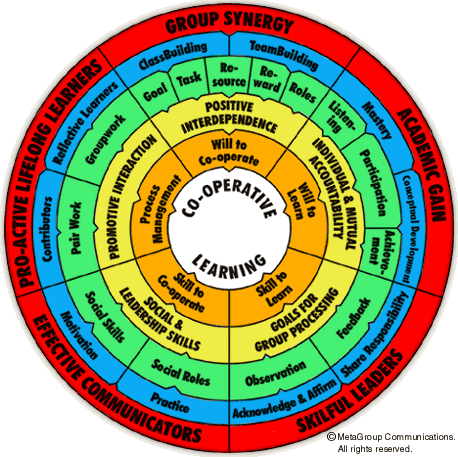
So I'm no stranger to cooperative learning and I'm actually a huge fan of it. I love the roles that are given and the, seemingly, seamless integration of them. I am, however, a bit intimidated by them. I think the best lessons, coop learning, magic tricks, ect are all made to look easy. For cooperative learning to be successful the student can't really see the gears moving so to speak. I guess what I mean by that is all the effort picking groups, picking the roles, the tasks all have to be done away from the student's eye.

 I think choosing who goes in what group is very tactical. You pick the people who can most help, and be helped, by the ones they are partnered with. Often in my own high school classes we'd fight so desperately to work with our friends. Not because we thought we'd get the most out of the lesson but because we wanted to goof off. I think understanding that the groups are rigged can sometimes have the same effect as a bad heart transplant. The students will reject the system and use what ever power they have to undermine the project. That being said I think that might only happen if the structure is not sewn into the fabric of the class. In one of the English classes at CF I saw that the teacher had a big board specifically designated to cooperative learning stuff. It listed all the roles and who would perform which role for that particular weeks project. What I liked about that is that it builds the concept into the students mind right away. It moves the student away from group work (which I feel is the term that best describes the idea wanting to work with your friends and goof off) and moves towards cooperative learning. The idea of roles and performance and become a part of the culture of that classroom community. It's not something that the teacher springs on them and has to spend 15 minutes explaining ever aspect of it. It's something that has been introduced to them along with the opening of the class at the beginning of the semester. It is understood that that is a normal and common aspect of that classroom.


I think the above picture represents what I like about cooperative learning pretty efficiently. Cooperative learning encompasses so many different learning opportunities in one exercise. The student learns content but they also earn social skills, team work, independence, and self mandated structure. I think it is admittedly one of the more important aspects of a classroom, if done well.