
Tuesday, October 29, 2013
My essential question
So I've been thinking about my essential question and I've been thinking about what kind of teacher I want to be. I want to be a teacher that has a good relationship with my students but I've had teachers who tried to be "the cool teacher" and it honestly made me respect them less. I don't want to be the 30 year old who is trying to have a bunch of 16 year old friends. I don't want to be the strict teacher that my students hate either. I remember a teacher I respected a lot who, when I went back to high school to interview him for a class i was taking, said he didn't believe it was his job to help students figure out who they were. He said his job was to teach them English and that's what he'd do. Anything else like aptitude tests, mentoring, and advice he said wasn't his business. I always loved his class when I was in high school and it confused me to hear this. I'm not surprised by this, not many of my teachers could have been considered the 'mentoring type'. I'm not sure that's what I want either but as a kid it would have been nice to have someone to go to about college nad the 'real world' that wouldn't just give me the same basic "go to college" answer that I'm sure most teachers feel obligated to say. I guess one essential question that I'm working around with is: What is my non instructor role as a teacher to my students? What do I owe my students and what line do I want to draw with them? How involved in my students lives do I want to be? This is a question that finds its way in my head a lot. I often wonder not only what kind of teacher do I want to be but what kind of teacher I'll end up being. I think what I want and what I find out works best for me might end up being too different things. After all I know so little about who I am as a teacher.


Monday, October 21, 2013
Libraries reading and attention span
So I was listening to a speech by a favorite author of mine where he talks about libraries. The speech can be found it its entirety through this link:
http://www.theguardian.com/books/2013/oct/15/neil-gaiman-future-libraries-reading-daydreaming
But I'll try and pick a few quotes out that I feel best capture the point I think one can make about schools and libraries.
http://www.theguardian.com/books/2013/oct/15/neil-gaiman-future-libraries-reading-daydreaming
But I'll try and pick a few quotes out that I feel best capture the point I think one can make about schools and libraries.
"Literacy is more important than ever it was, in this world of text
and email, a world of written information. We need to read and write, we
need global citizens who can read comfortably, comprehend what they are
reading, understand nuance, and make themselves understood.
Libraries
really are the gates to the future. So it is unfortunate that, round
the world, we observe local authorities seizing the opportunity to close
libraries as an easy way to save money, without realizing that they are
stealing from the future to pay for today. They are closing the gates
that should be open."
and
"Well-meaning adults can easily destroy a child's love of reading: stop
them reading what they enjoy, or give them worthy-but-dull books that
you like, the 21st-century equivalents of Victorian "improving"
literature. You'll wind up with a generation convinced that reading is
uncool and worse, unpleasant."
So I was thinking about how I could apply this to teaching, or at the very least the school system. So far there is one resource that (hopefully) all schools have. That is a library. There are good libraries and there are bad libraries but one thing most of them have are books and computers.
When I was observing I noticed a class utilizing the library and one thing I noticed was the lesson was largely computer based. Not a book on the shelf was used. Now this is not to say they don't use them, I could never really know that, but it got me thinking about my own high school days. During my time in school we had a library and a computer lab. They were separated by the vast hallways of the school. One couldn't, for instance, hop to the library and grab a book then go the the computer lab in say under a minute. There was generally a long trek involved. This amounted to a lengthy time in the computer labs and not a whole lot of time in the library. I think the only solid lesson we ever learned in the library was how to check out books, something we ended up never using as...well we had computers. I often wonder how the invasion of the digital has affected our way or reading. Students today are given millions of choices formed in compact easy to read, easy to access summaries. The problem is that in the digital age of email, text, and internet everything is so short. I worry that this leaves us with a shorter attention span then ones of earlier generations. I've certainly heard this argument made before.
So I thought about those quotes and I thought about libraries and reading. It's true that the short formed textual readings of the internet age are probably the preferred medium for children in high school and the young adults we find in college. These quotes, and largely this speech, seem to think they work together but I worry that they are actually at war. I described my library and computer lab with a vast distance partly because I feel like that distance exists in between the two mediums of reading. Partly it's out of convenience. A computer is certainly an easier source of information than a book but are we sacrificing endurance for speed?
I remember in math class we would always learn the hard way to doing a formula before learning the quick way. My teacher would always say it was so we'd learn to appreciate they easy when once we went through the hard way. We went through something like that with the fry readability in class a few weeks ago. I wonder if by skipping the teaching of research and learning through solid books and going straight to the internet are we robbing our students of the oppurtunity to appreciate the hunt for knowledge?
These are just some thoughts I had this week. What do you guys think? (also in theme with my blog, sorry for the long post haha.)
Monday, October 14, 2013
Cooperative Learning and Me.
So I'm no stranger to cooperative learning and I'm actually a huge fan of it. I love the roles that are given and the, seemingly, seamless integration of them. I am, however, a bit intimidated by them. I think the best lessons, coop learning, magic tricks, ect are all made to look easy. For cooperative learning to be successful the student can't really see the gears moving so to speak. I guess what I mean by that is all the effort picking groups, picking the roles, the tasks all have to be done away from the student's eye.
I think choosing who goes in what group is very tactical. You pick the people who can most help, and be helped, by the ones they are partnered with. Often in my own high school classes we'd fight so desperately to work with our friends. Not because we thought we'd get the most out of the lesson but because we wanted to goof off. I think understanding that the groups are rigged can sometimes have the same effect as a bad heart transplant. The students will reject the system and use what ever power they have to undermine the project. That being said I think that might only happen if the structure is not sewn into the fabric of the class. In one of the English classes at CF I saw that the teacher had a big board specifically designated to cooperative learning stuff. It listed all the roles and who would perform which role for that particular weeks project. What I liked about that is that it builds the concept into the students mind right away. It moves the student away from group work (which I feel is the term that best describes the idea wanting to work with your friends and goof off) and moves towards cooperative learning. The idea of roles and performance and become a part of the culture of that classroom community. It's not something that the teacher springs on them and has to spend 15 minutes explaining ever aspect of it. It's something that has been introduced to them along with the opening of the class at the beginning of the semester. It is understood that that is a normal and common aspect of that classroom.

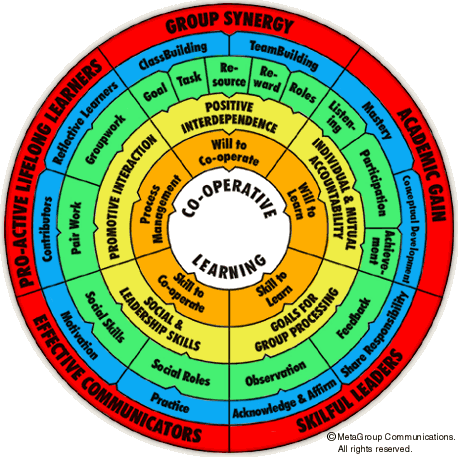
I think the above picture represents what I like about cooperative learning pretty efficiently. Cooperative learning encompasses so many different learning opportunities in one exercise. The student learns content but they also earn social skills, team work, independence, and self mandated structure. I think it is admittedly one of the more important aspects of a classroom, if done well.
I think choosing who goes in what group is very tactical. You pick the people who can most help, and be helped, by the ones they are partnered with. Often in my own high school classes we'd fight so desperately to work with our friends. Not because we thought we'd get the most out of the lesson but because we wanted to goof off. I think understanding that the groups are rigged can sometimes have the same effect as a bad heart transplant. The students will reject the system and use what ever power they have to undermine the project. That being said I think that might only happen if the structure is not sewn into the fabric of the class. In one of the English classes at CF I saw that the teacher had a big board specifically designated to cooperative learning stuff. It listed all the roles and who would perform which role for that particular weeks project. What I liked about that is that it builds the concept into the students mind right away. It moves the student away from group work (which I feel is the term that best describes the idea wanting to work with your friends and goof off) and moves towards cooperative learning. The idea of roles and performance and become a part of the culture of that classroom community. It's not something that the teacher springs on them and has to spend 15 minutes explaining ever aspect of it. It's something that has been introduced to them along with the opening of the class at the beginning of the semester. It is understood that that is a normal and common aspect of that classroom.
Wednesday, October 9, 2013
Life long learners.
Anyway I was thinking about what it means to be a life long learner and I stumbled upon this video. In this video the guy shows us how he had been tying a shoelace the wrong way his whole life. He goes on to show the right way and ends with the point that simple changes can yield great results. So I got to thinking how that could be used in teaching. It seemed to me that there are definitely many more opportunities to learn in life other than just how to tie your shoes. School seems like a lot but often times it really only scratches the surface of the knowledge that is out there in that given subject. I think as a teacher by tweaking how I present information it might yield me better results. Students often look at school as something to get through. They learn math, or english, or history, and they're done. They'll "never have to need it" in the real world. I don't know exactly how yet but i feel like there needs to be a change in how society views education. As a teacher I feel like that falls to me in some ways to make that change. I want to be able to show my students that learning doesn't end when we're out of school. I want them to know that learning is a tool that can make your life more interesting and more fulfilling. I'm not sure how to do that yet but I feel like it's not enough for students to learn, they also need to know how to learn, and why to learn.
Wednesday, October 2, 2013
Our second observation
So I mentioned last week that I had some apprehensions about marking negative observations in our walk through logs. I had been thinking about it all week going in and I was thinking a lot about the comments you guys put up as well. I find myself agreeing more with what you guys were talking about, namely not thinking about it as criticism and the use of language. I think one person posted a topic about how important word choices can be. Using words like "urban schooling" can be damaging. I think using positive language has helped me take more positive learning experiences out of our second observation. Going into it I tried to keep that in mind and I really think it shaped my viewing. In the end though I think I walked away with something else that is equally as important. Teaching isn't in the one day you view.
So looking at this I started thinking about how I view teachers and how sometimes I think people unfairly view them. Often times teachers are viewed as something other than people. Now this can be viewed as a good thing or bad but I think it's definitely there. Teachers are unfairly given expectations that no other job has. They're expected to be on at all times. I think that mentality can isolate them and when looking at small portions of their work (one day, one lesson, one 5 min block) one tends to inflate it and use it to represent the teacher as a whole. I'm starting to realize that that isn't the way to go. I watched a teacher in our last observation who used her knowledge that she gained through out the semester to best solve a classroom management problem. She knew enough about the child to know how best to handle that. Now it's not fair to expect that teacher to have known that the first day of class. That's something she had to build to. What I'm liking about these observations is that we get to see that growth. We start out fairly early in the year and we may see teachers who may not handle something the best way at first but through out the year they'll learn and pick up new tricks to help them along. Just like that teacher grew accustomed to her students behaviors so will most of the others. I think putting it in that light I'm more interested in these observations now as an opportunity to go through this journey with the teachers.
So looking at this I started thinking about how I view teachers and how sometimes I think people unfairly view them. Often times teachers are viewed as something other than people. Now this can be viewed as a good thing or bad but I think it's definitely there. Teachers are unfairly given expectations that no other job has. They're expected to be on at all times. I think that mentality can isolate them and when looking at small portions of their work (one day, one lesson, one 5 min block) one tends to inflate it and use it to represent the teacher as a whole. I'm starting to realize that that isn't the way to go. I watched a teacher in our last observation who used her knowledge that she gained through out the semester to best solve a classroom management problem. She knew enough about the child to know how best to handle that. Now it's not fair to expect that teacher to have known that the first day of class. That's something she had to build to. What I'm liking about these observations is that we get to see that growth. We start out fairly early in the year and we may see teachers who may not handle something the best way at first but through out the year they'll learn and pick up new tricks to help them along. Just like that teacher grew accustomed to her students behaviors so will most of the others. I think putting it in that light I'm more interested in these observations now as an opportunity to go through this journey with the teachers.
Thursday, September 26, 2013
Memory and Teaching.
I think it would work best to summarize it first just in case someone can't watch it, though I highly recommend it, it is very interesting. So this guy Joshua Foer was researching a memory competition for a quirky events piece. Turns out these people could remember crazy amounts of information in very small amounts of time (like a few hours) and the winner gets some kind of prize. The technique is called the "memory palace." Now some might remember hearing about this in small detail in CEP. Basically the technique involves picturing your house, or another familiar pathway, and populating it with strange symbols you've related to what you need to remember. He uses a nude bicycle race to remember the memory competition, Brittany Spears dancing in his living room to remember an anecdote involving her, and a few more as weird as that. Doing some scientific research he found that, after using brain scans, the people using this form of memory were using different parts of their brain than normal. Not only that they were using more of their brain and were able to recall more efficiently the things they remembered. It had do do with the visual section of their brain. It turns out that is where longer kept memories are formed.
Now I don't want to go too much into detail about it but what I was thinking was why not use this in class? He brings up a point about working more to remember and using your imagination. I was thinking as an English teacher I could use this to prompt my students to say visualize Hamlet. Maybe have them cast each character in the play and have them act them out in their heads. Maybe have them visualize a scene as we read. Often I worry that people read the wrong way. People read the words on the page but never let them come to life. I find I recall what I read better if I think about the passage as I'm reading it. If I really use my imagination to add another dimension to it.
So what do you think? Is there anyway something like this could be used in your content area?
Link: http://www.ted.com/talks/joshua_foer_feats_of_memory_anyone_can_do.html
Wednesday, September 25, 2013
Problem commenting
Is anyone else having problems commenting on other blogs? I find myself having a difficult time. Mostly whenever I write a comment I have to write it twice because the first time I publish it it just disappears. The second time I'm prompted to prove I'm not a computer by typing out those jumbled letter number things. I find myself unable to comment at all on a mobile device, which is annoying since I primarily use a tablet. I'm just wondering if anyone else has had this problem and if so any suggestions on how to fix it?
Subscribe to:
Posts (Atom)